Friday, March 20, 2020

Book Review of Speediest!: 19 Very Fast Animals


1.       Bibliography

Jenkins, Steve. 2018. Speediest!:  19 Very Fast Animals. New York:  Houghton Mifflin Harcourt. ISBN  1328841960

2.       Plot Summary

Jenkins takes the reader on a non-stop adventure through amazing information and data presented about the 19 fastest creatures on earth!  In this riveting book, young readers will marvel at the vivid, dreamlike collage illustrations of each creature that majestically stretch across the white pages in all their speedy glory.  Readers encounter the cheetah, the book cover's featured creature, and discover the top speed of this amazing animal to be a staggering 70 mph, which can only be sustained “for a minute or so.”  Also, the green basilisk lizard, found in Central and South America and nicknamed the “Jesus Christ lizard” due to its ability to “run across the surface of the water,” will be long remembered by young readers.  And, who could forget the aardvark, whose name means “’earth pig,’” and which boasts a top (burrowing!) speed of 8 fmp/mpm (feet per minute/meters per minute)?  Young readers and their parents/guardians and teachers will enjoy this addition to the canon of Steve Jenkins's work again and again, as each reading seems to unearth a newly discovered, scientific surprise.

3.       Critical Analysis

As Jenkins was awarded the Caldecott Honor for What Do You Do With A Tail Like This? (2004), his work carries the assurance of credible research and accurate scholarship.  Each of the 19 creatures showcased by Jenkins is superbly illustrated using Jenkins’s colorful, playful collage technique, which artistically blurs the line between photographic rendering and scientific drawings.  Indeed, the creatures veritably look as though they might just choose to speed right off the page.  Jenkins includes a scale graphic for each creature, comparing it to human size, keeping each entry relevant and digestible in the mind of the young reader.  Also, a keyed globe with textual data specifying where the creatures live is included.  Each creature’s “Top Speed” is declared in an authoritative, gray orb for easy reference.  Jenkins’s knowledgeable, engaging writing style is evidenced in each impeccably accurate paragraph, complete with subheading, about the creatures he selected for this work.  The organization of the work demonstrates true skill and dedication to the creation of a high-quality children’s nonfiction/informational text.

In addition to expertly delivered content on each creature included in Jenkins’s book, he also offers to the reader a useful table of contents, an introductory section on predators and prey (demonstrating an artful general-to-specific approach to the text), an excellent comprehensive, comparative bar chart displaying each creature’s mph/kph to encourage critical thinking, a handy glossary, and a bibliography section to encourage future scholarship.  As a former science teacher, I thoroughly recommend this work for its innovative, captivating content and style.

Reading Level 4.4
Ages 5-12

4.       Review Excerpt(s)

From Booklist:  “With attractive pictures and fascinating facts, these early readers will interest young animal lovers.”

5.       Connections

For a science connection lesson, students could focus on applying the data for rate (r), (“Top Speed”) in this book, to practice working with the distance formula,
d = rt [distance (d) = rate (r) x time (t)].

Students could randomly draw a craft stick or folded paper with one of the included creatures of this book written on it and then work in groups to write their own word problems using the rate data for their creature.  Then, students could teach their problems to the class.

For a science or nonfiction/informational English lesson, students could read, study, discuss, and even present other books by author Steve Jenkins, such as Stinkiest! (2018, ISBN  1328841979) and Trickiest! (2017, ISBN  9781328841957).  The content, writing style, illustrations, and presentation of data could be discussed and compared among these and other works by this author.


Book Review of The Right Word: Roget and His Thesaurus


1.       Bibliography

Bryant, Jen. 2014.The Right Word:  Roget and His Thesaurus. Ill. by Melissa Sweet. Grand Rapids, MI: Eerdmans Books for Young Readers.  ISBN  0802853854

2.       Plot Summary

The Right Word:  Roget and His Thesaurus tells the fascinating story of Peter Mark Roget and the creation of one of the world’s most valuable resources in 1852—his Thesaurus, which we learn, is Greek for “treasure house.”  Roget was born in London, England in the year of 1779 and had one sister, Annette.  His father died of tuberculosis when he was very young, and he moved often as a child.  He prolifically wrote lists as a child, often in Latin and English, and amazingly wrote his first draft of his masterpiece, his Thesaurus, when he was merely 26 years old.  Peter became a medical doctor at the young age of 19, but he worked as a tutor until he was old enough to garner respect as a practicing medical doctor.  He, all the while, continued to create his lists.  Roget married and had two children, and these adoring children encouraged their father to publish his Thesaurus—and, thankfully, he did so.  He wanted his book to be accessible to all readers, not just the elite of the time:  “Long ago Peter had discovered the power of words.  Now he believed that everyone should have this power—everyone should be able to find the right word whenever they needed it.”  Interestingly, readers learn that Roget also invented the slide rule and the portable chess set!  Roget remained loyal to his path as a thinker and innovator, all the while exuding a quiet confidence and humility.

              Ages 5-12

3.       Critical Analysis

Bryant and Sweet’s acclaimed work on Roget and his Thesaurus allow readers to observe and understand a life lived in quiet brilliance.  The inclusion of both a “Sources” and a “Selected Bibliography” section lend credibility to the work, as does the extensive “List of Principal Events” of Roget’s life, with notable world events included.  Bryant’s storytelling skillfully weaves the cloth of Roget’s life in a manner that contextualizes his life stages and accomplishments.  The “Author’s Note” and “Illustrator’s Note” both contribute authenticity to the approach of the work, and the passion for the project is evident in each creators’ approach and command of the subject.  As Sweet declares in her illustrator’s note, “[t]he proverbial thunderclap sounded at the start of my research when I held Roget’s original 1805 word book in my hands.”  These bookmakers—Bryant and Sweet—are bona fide  talents, as they have previously demonstrated in A River of Words:  The Story of William Carlos Williams (2008).  Moreover, the chronological style of this whimsical yet realistic biography lends a workability to the organizational structure.  A “For Further Reading” section is included for curious students who want to learn more.

Bryant and Sweet’s collective design and style of this work are synergistically more together than they could ever be alone.  Bryant’s precise, confident writing style matched with the combination of painterly and unconventional, innovative collage techniques invites young readers in to explore the new world of Roget and how he lived, what happened to him, and what he accomplished in this world.  Sweet’s inclusion of numerous complex lists throughout the work, interspersed with vibrant images and hues, serves to anchor the reader to the specific brilliance and talent possessed by Roget which destined him to create his Thesaurus.  Bryant’s dedication to telling the story of this “fascinating life” is evident on every page (Author’s Note).  Readers will assuredly find this biography of Roget to be a welcome addition to their bookshelves and the story within an unforgettable experience of mind and heart.

4.       Review Excerpt(s)

            2015 Caldecott Honor Book
            2015 Sibert Medal Winner

            From Booklist:  "In brilliant pages teeming with enthusiasm for language and learning, Bryant and Sweet (A Splash of Red, 2013) joyfully celebrate curiosity, the love of knowledge, and the power of words."

From Kirkus Reviews:  “In a word:  marvelous!”

5.       Connections

For an English/creative writing connection lesson, students could also read A River of Words:  The Story of William Carlos Williams (2008), also written by Jen Bryant and illustrated by Melissa Sweet (ISBN  0802853021) and discuss the similarities and differences regarding the storytelling and illustrating styles utilized in both works.

An additional English/creative writing connection could be an experiential lesson on how to use Roget’s thematic as well as his alphabetical Thesaurus and having students use the Thesaurus to write an essay or a story with a predetermined amount of “new to them” words, circled or highlighted and defined, depending on age and grade level.  


Wednesday, March 18, 2020

Book Review of The Lincolns: A Scrapbook Look at Abraham and Mary


1.     Bibliography

Fleming, Candace. 2005. The Lincolns:  A Scrapbook Look at Abraham and Mary. New York:  Schwartz & Wade Books.  ISBN  0375836187

2.     Plot Summary

The Lincolns:  A Scrapbook Look at Abraham and Mary affords the reader an otherworldly, vivid view into the inner-workings of the lives of Abraham and Mary Lincoln.  The reader is able to truly study the developmental influences of both figures to an exacting degree, which yields an uncanny perceptivity into their adult lives and decisions.  The harsh realities of unmitigated diseases such as typhoid, cholera, and milk sickness, as well as the heightened dangers of childbirth at this time in American history, coupled with the obstructions which hindered educational and economic access, create a period in history that deeply barraged many early Americans with profound hardship and grief.  The Lincolns were no exception.  As they entered the political realm, Abraham carried his hatred for slavery with him, as his law partner William Herndon recalled, “Against this inhumanity his sense of right and justice rebelled.”  Mary shared this intense hatred for slavery, and they were destined to bring America to the state of abolished slavery across the nation.  Indeed, the reader learns that Abraham’s copy of his favorite book Aesop’s Fables was habitually by his side, where he no doubt garnered the wisdom of “the tale of the lion and the four bulls with its moral:  A kingdom divided against itself cannot stand.”  Fleming’s book equally tells the story of two positively brilliant figures in American history who carried the burden of a chasmically factional nation and succeeded in delivering this nation to a state of maturity that would ultimately allow it to begin to truly heal and thrive.

Reading level 8.6,
Interest level 3rd-12th grades

3.     Critical Analysis
                                   
Fleming’s painstakingly accurate research and writing is evidenced on every page of this finished work; indeed, she includes in her Acknowledgments section that every fact is verified by retired professor Dr. Herbert Lasky, Eastern Illinois University.  Further, Fleming is a respected biographer of other titles, such as Our Eleanor (2005) and Ben Franklin's Almanac (2003).  Her Notes and References for The Lincolns:  A Scrapbook Look at Abraham and Mary are impeccably completed.  Replete with documentable dialogue, Fleming's work succeeds in telling the objective, authentic stories of Abraham and Mary Lincoln's lives and how they intertwined in a love story that was true, complex, and loyal (Vardell 266).

The organization of this masterful work, a traditional scrapbook style, proves very intimate and personal.  Readers will find themselves getting completely engrossed in the reading, unaware of the passing of time.  Fleming’s logical, chronological layout lends an orderly, authoritative manner to the book.  The introduction and chronology of both lives prefaces the biography, and reference aids such as chapters, subheadings, and an index serve the reader well in his or her study of Abraham and Mary Lincoln.  A section in the end pages offers additional print and electronic resources for further study, a beautifully written supplemental explanation regarding the research, and exhaustive notes for all of the references contained in the biography.

Regarding the design of this treasure of a book, Fleming includes “A Note on the Type” to inform the reader that the typeface Old Times American, an old fashioned typeface, is used, which results in an attractive, authentic feel for the text of Fleming’s work.  Moreover, the black and white photos and black print on large, white background is intriguing and rather gives the sense that one is thumbing gingerly through old, original historical documents found in a long-forgotten trunk in an attic from antiquity.  The layout certainly supports and enriches the delivery of the subject matter, and the included maps prove fascinating and richly enhance the overall value of the text.

Fleming states in her section in the end pages that offers additional information about the research process for the book that her five years of researching and writing this biography allowed her to “[feel] the Lincolns begin to take shape for [her].  They began to form in [her] heart and in [her] mind until they were no longer merely historical figures but human beings, solid and concrete.”  With her alchemical, precise, and compassionate writing abilities, Fleming breathtakingly succeeds in transferring this coming to life to the reader of her work.

This biography will powerfully open minds, change lives, and shape decisions of young readers to be more conscientious, steadfast learners, helpers, builders, leaders, and redeemers in their lives and in our world—a must read for all students….


Vardell, Sylvia M. 2019. Children's Literature in Action:  A Librarian's Guide (Third Edition). Santa Barbara:  Libraries Unlimited.

4.     Review Excerpt(s)

Boston Globe-Horn Book Award for Excellence in Children's Literature, 2009

Cybils Award, 2008, Finalist, Non-Fiction Middle Grade and Young Adult

Flora Stieglitz Straus Award, 2009

Los Angeles Times Book Prize, 2008, Finalist, Young Adult Literature

Norman A Sugarman Children's Biography Award, 2010, Honor, Children's Biography Award

Orbis Pictus Award, 2009, Honor Book


From Children's Literature:  "This book needs to be a definite addition to any school library."

From Kirkus Reviews:  "The scrapbook technique, used previously in Our Eleanor (2005) and Ben Franklin's Almanac (2003), remains fresh and lively, a great way to provide a huge amount of information in a format that invites both browsing and in-depth study."

5.     Connections

For a history connection, students could also read a biography of Frederick Douglass and/or Russell Freedman’s Abraham Lincoln and Frederick Douglass:  The Story Behind an American Friendship (ISBN  0547385625) and discuss, analyze, and write reflections upon the connections, collaborations, and conflicts between Lincoln and Douglass.

For an additional history connection, students could read and study the Underground Railroad and read a biography of Harriet Tubman, discussing the abolitionist movement in American history and Mary and Abraham’s anti-slavery beliefs and convictions.

For an English connection, students could read, discuss, and write response essays on Walt Whitman’s poem “Oh Captain! My Captain!” and discuss and analyze the profound role of Lincoln upon the history of America.

For a history or social/women's studies lesson, students could discuss and analyze the proposed role of the American housewife as early Americans evolved from lives lived primarily in rural, prairie settlements to more industrialized, mercantile-based communities and how Mary’s life and behavior were scrutinized from this popularized, caricatured perspective.

For an ethics lesson, students could discuss ethics in law practice, as relates to Mary Lincoln’s insanity trial; ethics in journalism (and the evolution of such) could also be discussed as related to the media’s portrayal of the Lincolns and compared/contrasted with other significantly factional periods in American and world history.

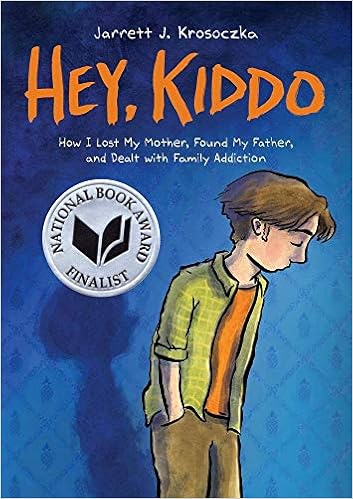
Book Review of Hey, Kiddo

1.        BIBLIOGRAPHY Krosoczka, Jarrett J. 2018. Hey, Kiddo . New York: Graphix, Scholastic. ISBN 978-0-545-90248-9 2.        PL...